Oh, Miles. Will you ever stop being awesome? This past Wednesday, Lost aired its season-5 finale. I am blogging about it. There are spoilers. You have been warned.
Of course every yahoo with an Internet connection and one of these here web-logs has probably already prognosticated about the various ins and outs of Season 5's "The Incident" two-parter, from the (disappointing, at least for now) reveal of Jacob and his ideological opposite to my being totally wrong about Ilana and her boys being DHARMA bums. (Oh, well. I was right about Fringe and I can safely stay smug about that for another day or two.)
I don't really care about that. Most of the episode, up to and including the surprise deaths (one of which was unfortunately unintentionally HILARIOUS) that usually attend these things, was about moving pieces into place for season 6. What interests me though is that line from Miles, snarky as always, positing that Jack with all his faith in Faraday's science, is going to come around and actually cause the incident he's trying to prevent.
What interests me is this show's apparent take on time travel vs. free will. I'm a big fan of science fiction, as anybody can tell you, and sci fi, at least when it tries to market itself to the masses, has to take this cushy notion that our free will overrides the law of the universe. Think Back to the Future. Marty McFly goes back in time and because he has free will, because he has agency, he fucks up the universe by accidentally making out with his Mom, then fixes the universe by helping his Dad stop being a complete milquetoast.
Sorry if I just also spoiled Back to the Future for you.
The point is I can name at least a dozen other movie and TV time-travel escapades which all follow this pattern. Hell, it happens again in Back to the Future II for God's sake, with Doc Brown on hand to give us a tidy lecture on the creation of alternate realities. This is easy. It fits our instincts. I've had one reputable physicist explain to me that I can't actually hit a cue ball back through a wormhole and hit the eight ball in the past. That I would be physically prevented from actually altering the past, even if I could travel there, which, okay, is probably impossible anyway.
Sorry. That sentence got away from me a bit there. Wibbly wobbly, timey wimey. Jack, I think, and by extension Faraday, is wildly delusional when he thinks his purpose in being thrown back in time is to stop the event that got him started on the path that eventually put him back in time. It's like the Terminator, right? The Terminator travels back in time to kill Sarah Connor so she can't give birth to the future Anti-Robot Jesus. Only Anti-Robot Jesus of the future sends a soldier back to stop the Terminator. The soldier impregnates Sarah Connor, because apparently you have time to do that sort of thing when you're on the run from an evil Austrian robot. So the Terminator's caught in a loop. He gets sent back to change something and ends up causing it.
But what if he succeeded? And what if Jack succeeded? It's the headache of time travel, it's why we invent whole parallel universes around the outcomes of our decisions. If Jack's bomb cancels out the EM effect that caused his plane to crash, then Jack isn't around to, five seasons later, get whisked back to 1977 to detonate the bomb to cancel out the EM effect...you get the idea.
Of course the problem with this time travel logic is that it has the effect of robbing your time travel story of any urgency. If your Killer Austrian Robot is always stopped, if Biff never becomes super-rich, if the plane never crashes, then all we're doing is going through the motions.
I think this whole thing can be viewed through the prism of an earlier episode, "Whatever Happened, Happened." Sayid shoots kid-Ben, reasoning that if kid-Ben snuffs it in 1977, he can never do all the terrible things that adult-Ben will do that put Sayid on his path, the path that tells him shooting a thirteen-year old is a good idea. Same with Jack. Jack's not gonna stitch him up, so Kate and Saywer take kid-Ben to Richard, and pretty much guarantee the little boy's going to grow up a Class A Creepy Fuck.
This has nothing to do with physics. Jack and Sayid and Kate and Sawyer still have their free will intact. It has to do with determinism. Everything that happened to Sayid up to the point that he pulls the trigger made him what he is, made him the man to pull that trigger. Same with the others. The chains we wear are of our own making. That's a heck of a statement for a TV show to make, I think. To say that the fate of the world rests on the fact that we simply cannot change our stripes. And that's what destiny is, then. The inexorable march of history, political and personal, toward the end. And there is, as Jacob says, only one end. Everything up 'till then is progress.
I guess we'll see in January.
Sunday, May 17, 2009

Saturday, May 9, 2009
The Stars My Destination
My earliest memory is a fragment. I am sitting in the back seat of my father's car. I am three years old. My father and my mother and I are at the drive-in. I am staring up at the screen, enthralled. The movie in question is Star Trek III: The Search for Spock. Captain Kirk has arrived in Spock's quarters to find his friend Dr. McCoy there, burdened as it turns out with the carrying of his dead friend's soul. He speaks to Kirk in Spock's voice.
I was a Trekkie from an early age.
Appropo of the film itself, let's indulge in a little time travel. It's 2005. Star Trek: Enterprise has just been canceled, the fifth Star Trek TV series and the first since the franchise was relaunched to be canceled before its seven-season run ended. Enterprise lasted just four years. Three years earlier, the tenth film, Nemesis, stumbled in to theaters a colossal disappointment. The franchise appeared near dead. So someone advances the notion, something that had been around since 1991, of recasting the original series crew, of telling the story of them at their old academy days. Years go by, and finally, finally this idea starts to get some traction.
I was ambivalent to this idea from the start. Of course it made sense, rebrand your product using its most famous names. And ever since the first movie went to screens ten years after the original show was canceled, Star Trek has always been a movie series about, well, older people, and that just doesn't sell. Still, I didn't like the idea of someone stepping in to the venerable shoes of Captain Kirk, a man, however fictional, who was a big part of my life growing up.
Then came that trailer.
So I'm a trailer slut. What can I say? I was hooked.
Tonight I saw Star Trek. And let me tell ya: awesome. I should admit if it's not obvious by now that I'm incapable of being objective about this film, of reviewing it in the context of a film. I would not be an impartial juror. So let me tell you what I think in the context a hundred million other geeks are even now: how this film fits in with my childhood.
This movie is epic. From the first space battle to those two words, larger than life on the big screen, we are bombarded with massive sets, lots of punches, monsters, phaser fire being thrown here and there, guys jumping from space on to a big platform thing, planets in peril. One thing Star Trek never really had much of was scope, and that's a major benefit here. In their hopes of catering to a wider audience, director JJ Abrams and the producers of the film did what Americans have done best for decades: they threw millions and millions of dollars at the thing and it turned out it worked greatly to their advantage.
Really, it's hard for me to say anything bad about it, which seems to make writing out any sort of a review next to impossible. The film achieves what it sets out to achieve, and it does it in spades.
I wasn't sure about either Simon Pegg for Scotty or Karl Urban for McCoy, but both simply throw themselves in to their roles. Urban in particular cultivates DeForest Kelly's speech patterns, doing a dead-on impression without lapsing in to parody. Pegg is a delight. He isn't all that Scotty-like, but he's a fantastic comedian and he more than makes up for it. Chris Pine gets saddled with playing Kirk, and he wisely steers completely clear of Shatner's. Unique. Linedelivery! Zachary Quinto does great as Spock.
It's funny, too, in a naturalistic way that Star Trek has rarely managed well. The original series could be pretty amusing at times (some times not at all intentionally), but by the time the spinoff shows rolled around, the franchise seemed a bit stately and stolid and incapable of making any jokes that were not forced. (I'm looking at you, every single "funny" Deep Space Nine episode.) Here there are funny bits, quick quips thrown in as the film shoots along at its breakneck pace, but never in a way that distracts from the central danger.
And Leonard Nimoy comes back. In a move designed to tie this film in to the established Trek continuity, Nimoy's Spock is back from the future (well, further in the future anyway) trying to stop some other guys from the future from messing with history. It sounds complicated, and the exposition that Nimoy has to deliver is a bit of a stumbling block in the film's second act, briefly slowing to a crawl the movie's previously warp-speed pacing. But the film adroitly picks up steam again and you know all you need to know. Bad guy. Big gun. Gonna blow up Earth.
Of all the elements of the film, Nimoy's involvement caused me the most trepidation. It seemed like a good idea to simply make a clean break from the established history of the show, and putting on a guy who was in it 40 years ago does not seem the way to do that. I could easily see it turning prospective casual viewers off the idea. But the arrival of Future Spock is handled pretty gracefully and the film makes all-or-nothing significant breaches from established continuity. I see this as a good thing. David Gerrold (who wrote 'Trouble with Tribbles' for the show in '67) called Trek's continuity adherence (and, really, any TV show's) "hardening of the arteries." You establish a thing is done one way in one episode, it has to be done that way again, and pretty soon you've closed off a lot of your options. This film leaves the playing field wide open.
Humbug. Good reviews are no fun. Is there anything bad to say about this movie? I hated the sets for one thing, too "Apple Store." Overly contemporary designs have a way of dating themselves almost immediately. And there are a couple of instances of truly bizarre product placement. Apparently both Nokia and Budweiser are going to be around in three hundred years.
These are minor quibbles. And even speaking as a fan I think that non-fans will get plenty of enjoyment out of it. Subtract the numerous references to the original show and you still get a great adventure movie, and the original Star Trek at least is so culturally well known that the movie's "I'm a doctor, not a..."s and Logic vs. Emotion stuff won't fly over the heads of too many people who don't live in caves.
A fun time was had by all.
I was a Trekkie from an early age.
Appropo of the film itself, let's indulge in a little time travel. It's 2005. Star Trek: Enterprise has just been canceled, the fifth Star Trek TV series and the first since the franchise was relaunched to be canceled before its seven-season run ended. Enterprise lasted just four years. Three years earlier, the tenth film, Nemesis, stumbled in to theaters a colossal disappointment. The franchise appeared near dead. So someone advances the notion, something that had been around since 1991, of recasting the original series crew, of telling the story of them at their old academy days. Years go by, and finally, finally this idea starts to get some traction.
I was ambivalent to this idea from the start. Of course it made sense, rebrand your product using its most famous names. And ever since the first movie went to screens ten years after the original show was canceled, Star Trek has always been a movie series about, well, older people, and that just doesn't sell. Still, I didn't like the idea of someone stepping in to the venerable shoes of Captain Kirk, a man, however fictional, who was a big part of my life growing up.
Then came that trailer.
So I'm a trailer slut. What can I say? I was hooked.
Tonight I saw Star Trek. And let me tell ya: awesome. I should admit if it's not obvious by now that I'm incapable of being objective about this film, of reviewing it in the context of a film. I would not be an impartial juror. So let me tell you what I think in the context a hundred million other geeks are even now: how this film fits in with my childhood.
This movie is epic. From the first space battle to those two words, larger than life on the big screen, we are bombarded with massive sets, lots of punches, monsters, phaser fire being thrown here and there, guys jumping from space on to a big platform thing, planets in peril. One thing Star Trek never really had much of was scope, and that's a major benefit here. In their hopes of catering to a wider audience, director JJ Abrams and the producers of the film did what Americans have done best for decades: they threw millions and millions of dollars at the thing and it turned out it worked greatly to their advantage.
Really, it's hard for me to say anything bad about it, which seems to make writing out any sort of a review next to impossible. The film achieves what it sets out to achieve, and it does it in spades.
I wasn't sure about either Simon Pegg for Scotty or Karl Urban for McCoy, but both simply throw themselves in to their roles. Urban in particular cultivates DeForest Kelly's speech patterns, doing a dead-on impression without lapsing in to parody. Pegg is a delight. He isn't all that Scotty-like, but he's a fantastic comedian and he more than makes up for it. Chris Pine gets saddled with playing Kirk, and he wisely steers completely clear of Shatner's. Unique. Linedelivery! Zachary Quinto does great as Spock.
It's funny, too, in a naturalistic way that Star Trek has rarely managed well. The original series could be pretty amusing at times (some times not at all intentionally), but by the time the spinoff shows rolled around, the franchise seemed a bit stately and stolid and incapable of making any jokes that were not forced. (I'm looking at you, every single "funny" Deep Space Nine episode.) Here there are funny bits, quick quips thrown in as the film shoots along at its breakneck pace, but never in a way that distracts from the central danger.
And Leonard Nimoy comes back. In a move designed to tie this film in to the established Trek continuity, Nimoy's Spock is back from the future (well, further in the future anyway) trying to stop some other guys from the future from messing with history. It sounds complicated, and the exposition that Nimoy has to deliver is a bit of a stumbling block in the film's second act, briefly slowing to a crawl the movie's previously warp-speed pacing. But the film adroitly picks up steam again and you know all you need to know. Bad guy. Big gun. Gonna blow up Earth.
Of all the elements of the film, Nimoy's involvement caused me the most trepidation. It seemed like a good idea to simply make a clean break from the established history of the show, and putting on a guy who was in it 40 years ago does not seem the way to do that. I could easily see it turning prospective casual viewers off the idea. But the arrival of Future Spock is handled pretty gracefully and the film makes all-or-nothing significant breaches from established continuity. I see this as a good thing. David Gerrold (who wrote 'Trouble with Tribbles' for the show in '67) called Trek's continuity adherence (and, really, any TV show's) "hardening of the arteries." You establish a thing is done one way in one episode, it has to be done that way again, and pretty soon you've closed off a lot of your options. This film leaves the playing field wide open.
Humbug. Good reviews are no fun. Is there anything bad to say about this movie? I hated the sets for one thing, too "Apple Store." Overly contemporary designs have a way of dating themselves almost immediately. And there are a couple of instances of truly bizarre product placement. Apparently both Nokia and Budweiser are going to be around in three hundred years.
These are minor quibbles. And even speaking as a fan I think that non-fans will get plenty of enjoyment out of it. Subtract the numerous references to the original show and you still get a great adventure movie, and the original Star Trek at least is so culturally well known that the movie's "I'm a doctor, not a..."s and Logic vs. Emotion stuff won't fly over the heads of too many people who don't live in caves.
A fun time was had by all.
Sunday, April 19, 2009
Saturday, April 11, 2009
Police Cops
I was watching Lost the other night. There was a cop show following, a not-entirely-unenjoyable cop show at that, but it got me and my friend thinking: just how many cop shows are on the air? After perusing imdb's TV listings, I've come up with the following list:
Forensic Science Shows:
CSI: Original Recipe
CSI: Miami
CSI: New York
NCIS
Cop Shows:
Castle
Life
The Unusuals
Flashpoint
Southland
Cold Case
Shows about the FBI:
Fringe
The Mentalist
Bones
Criminal Minds
Numb3rs
Without a Trace
Law and Order variations:
L&O: Original Recipe
L&O: SVU
L&O: CI
For convenience's sake I'm sticking to broadcast networks (sorry, The Closer and Sue Thomas, F.B.Eye). Nineteen shows, spread out over the course of a week. That's almost three a day, for those of you playing Basic Arithmetic, the Home Game. So I had a thought. A once-in-a-lifetime Primetime TV event: Every cop show, every night, every network. Different teams, different approaches, but they all must solve the exact same murder.
Not a crossover. Rather, here's how it works: With only minor geographic changes, the story of, let's say, a prominent investment banker who was beaten to death with a name-brand shoe outside The West 43rd Savings and Loan. His money is in his pocket, this was no robbery. Now, each show's crack detective team, from CSI Miami's Horatio Caine and his sunglasses and crappy one-liners to Fringe's Walter Bishop and his mind control swimming pool, must each interview the suspects, uncover the evidence, make with the snarky, and solve the murder. Every cop show, every night.
You could have big-name guest stars, real method guys who'd have no problem putting the exact same spin on the exact same murder case, night after night, for what amounts to the better part of three weeks. We'd become familiar with their ins and outs. CSI's crew obsesses over tiny shards of glass while Bones Feds deal with the impact of Nike tread on someone's skull and The Mentalist himself gets all wiggy with potential suspects.
Each suspect is asked the same questions, slightly differently. The jokes are new, the banter and the b-plots of course there to keep us interested, since by Monday night we all know the score. But it's fun to watch them, dancing over and around the same evidence, coming to the same conclusions at just the last second, sparing the innocent man and damning the guilty. Upholding justice. Saving the day, every day.
It'd be awesome.
Forensic Science Shows:
CSI: Original Recipe
CSI: Miami
CSI: New York
NCIS
Cop Shows:
Castle
Life
The Unusuals
Flashpoint
Southland
Cold Case
Shows about the FBI:
Fringe
The Mentalist
Bones
Criminal Minds
Numb3rs
Without a Trace
Law and Order variations:
L&O: Original Recipe
L&O: SVU
L&O: CI
For convenience's sake I'm sticking to broadcast networks (sorry, The Closer and Sue Thomas, F.B.Eye). Nineteen shows, spread out over the course of a week. That's almost three a day, for those of you playing Basic Arithmetic, the Home Game. So I had a thought. A once-in-a-lifetime Primetime TV event: Every cop show, every night, every network. Different teams, different approaches, but they all must solve the exact same murder.
Not a crossover. Rather, here's how it works: With only minor geographic changes, the story of, let's say, a prominent investment banker who was beaten to death with a name-brand shoe outside The West 43rd Savings and Loan. His money is in his pocket, this was no robbery. Now, each show's crack detective team, from CSI Miami's Horatio Caine and his sunglasses and crappy one-liners to Fringe's Walter Bishop and his mind control swimming pool, must each interview the suspects, uncover the evidence, make with the snarky, and solve the murder. Every cop show, every night.
You could have big-name guest stars, real method guys who'd have no problem putting the exact same spin on the exact same murder case, night after night, for what amounts to the better part of three weeks. We'd become familiar with their ins and outs. CSI's crew obsesses over tiny shards of glass while Bones Feds deal with the impact of Nike tread on someone's skull and The Mentalist himself gets all wiggy with potential suspects.
Each suspect is asked the same questions, slightly differently. The jokes are new, the banter and the b-plots of course there to keep us interested, since by Monday night we all know the score. But it's fun to watch them, dancing over and around the same evidence, coming to the same conclusions at just the last second, sparing the innocent man and damning the guilty. Upholding justice. Saving the day, every day.
It'd be awesome.
Thursday, April 9, 2009
Wednesday, April 8, 2009

Sunday, April 5, 2009
Waiting in the Sky
Gather 'round, children, to hear the tale from the halcyon days of the mid-nineties, a time when money flowed like wine, wine flowed like even more wine, and the national debt was something Chris Rock made fun of in ads for KFC. Gather 'round to hear of the Greatest Superhero Movie you'll never see. Gather 'round to hear of Starman.
No. Not the movie with The Dude. Or the short-lived TV show with the guy from 'Airplane.' No, to tell the story of the Starman, we'll have to take a trip back to 1940, with DC's 'Adventure Comics.'
By 1940, superheroes were a solid win for the comics industry, pushing the western, aviation and detective stories farther back in to the support columns. Along with debuting their first superhero group, the Justice Society, DC unveiled a few new characters, among them Ted Knight, the Starman.
Ted's thing was that he was a millionaire playboy. Heard that before? Well, this time he's a millionaire playboy astronomer, one who designed a mechanical rod powered by cosmic energy. In true comic book form, Ted takes his invention, which easily could have revolutionized the energy industry, and dons some tights and beats the crap out of people with it. Starman was born.

And he was kind of generic. He had a cool gadget, but so did the Green Lantern, he was a millionaire playboy and a scientist, but comics were full of millionaire playboys who didn't have to pull double-duty on the telescope circuit. Poor Ted's adventures didn't quite make it out of the Fifties.
Ah, but they had the name, and a string of reboots and recharacterizations followed. Oh, to be a second-stringer in the DCU.
Which brings us to 1994. As part of a plan to revitalize some of its underused names, DC decided to relaunch Starman. Of these reboots, it would be the only one that would take.

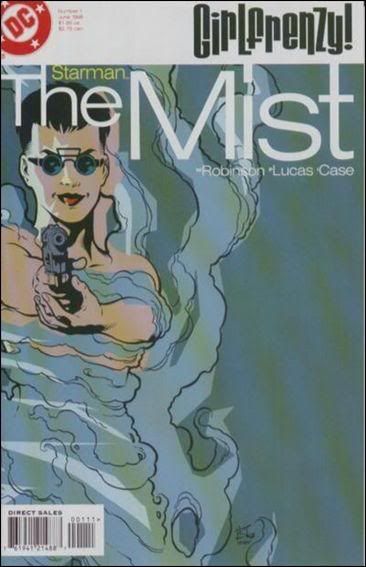
That guy in the goggles, that's our boy. Jack. The son of the original Starman. And here's where the plot of the Unmade Movie comes in to play. Jack doesn't start out wanting to be Starman. His brother's doing fine with the job and he and Jack don't get along. That's right up until Davey is snipered from a rooftop and the city erupts in flames. The Mist, Ted's old nemesis from the Forties is back, and he's got his own kids in tow, the vicious, murdering Kyle and the shrinking violet Nash.
Thrust in to the whole adventuring thing, and eager to avenge the death of his brother, Jack comes face to face first with Nash, who lets him go and later with the old man himself and Kyle, who killed his brother. Jack kills Kyle and the police nab both The Mist and Nash.
Boom. There's your first movie. Only Nash, she goes a bit crazy. She busts out of jail and proceeds to terrorize Jack and the city. And this is where it gets good, really. These two characters, two superheroes, are trapped in this cycle of violence started by their parents. In his seven years running the title, James Robinson deftly reinvented what it means to be a costumed hero and the pervasive nature of violence. Also, the man clearly loved comic books.

There was going to be a Starman TV show on the WB back when Smallville was first starting out and was a big hit, but the other superhero show on WB, Birds of Prey, tanked and the Starman idea was left to one side. Too bad. He's still out there, Hollywood. Waiting in the sky.
No. Not the movie with The Dude. Or the short-lived TV show with the guy from 'Airplane.' No, to tell the story of the Starman, we'll have to take a trip back to 1940, with DC's 'Adventure Comics.'
By 1940, superheroes were a solid win for the comics industry, pushing the western, aviation and detective stories farther back in to the support columns. Along with debuting their first superhero group, the Justice Society, DC unveiled a few new characters, among them Ted Knight, the Starman.
Ted's thing was that he was a millionaire playboy. Heard that before? Well, this time he's a millionaire playboy astronomer, one who designed a mechanical rod powered by cosmic energy. In true comic book form, Ted takes his invention, which easily could have revolutionized the energy industry, and dons some tights and beats the crap out of people with it. Starman was born.
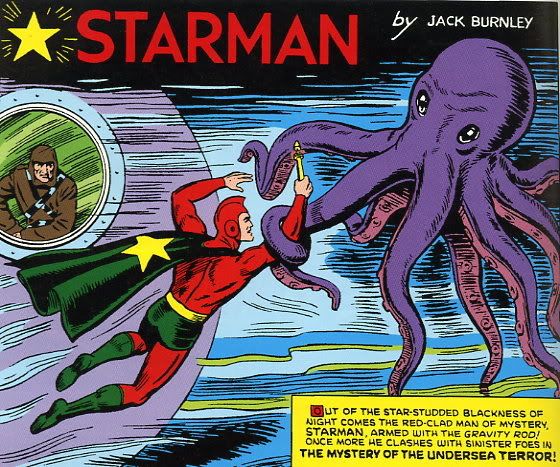
And he was kind of generic. He had a cool gadget, but so did the Green Lantern, he was a millionaire playboy and a scientist, but comics were full of millionaire playboys who didn't have to pull double-duty on the telescope circuit. Poor Ted's adventures didn't quite make it out of the Fifties.
Ah, but they had the name, and a string of reboots and recharacterizations followed. Oh, to be a second-stringer in the DCU.
Which brings us to 1994. As part of a plan to revitalize some of its underused names, DC decided to relaunch Starman. Of these reboots, it would be the only one that would take.
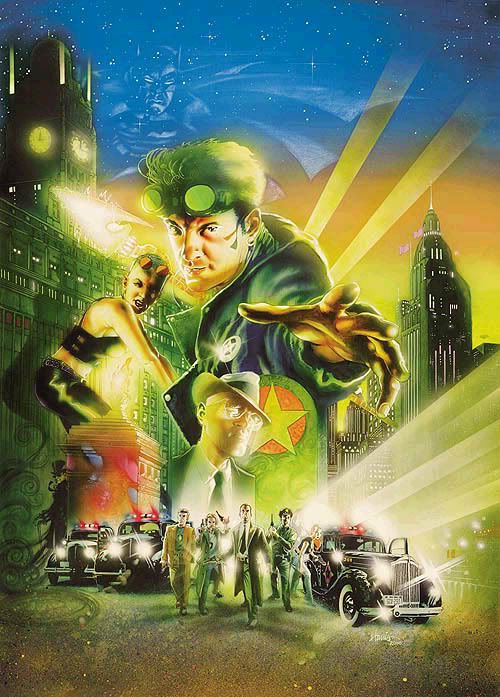
That guy in the goggles, that's our boy. Jack. The son of the original Starman. And here's where the plot of the Unmade Movie comes in to play. Jack doesn't start out wanting to be Starman. His brother's doing fine with the job and he and Jack don't get along. That's right up until Davey is snipered from a rooftop and the city erupts in flames. The Mist, Ted's old nemesis from the Forties is back, and he's got his own kids in tow, the vicious, murdering Kyle and the shrinking violet Nash.
Thrust in to the whole adventuring thing, and eager to avenge the death of his brother, Jack comes face to face first with Nash, who lets him go and later with the old man himself and Kyle, who killed his brother. Jack kills Kyle and the police nab both The Mist and Nash.
Boom. There's your first movie. Only Nash, she goes a bit crazy. She busts out of jail and proceeds to terrorize Jack and the city. And this is where it gets good, really. These two characters, two superheroes, are trapped in this cycle of violence started by their parents. In his seven years running the title, James Robinson deftly reinvented what it means to be a costumed hero and the pervasive nature of violence. Also, the man clearly loved comic books.
There was going to be a Starman TV show on the WB back when Smallville was first starting out and was a big hit, but the other superhero show on WB, Birds of Prey, tanked and the Starman idea was left to one side. Too bad. He's still out there, Hollywood. Waiting in the sky.
Subscribe to:
Posts (Atom)

 Posts
Posts